As a reminder, we bought our kitchen cabinets used and as such, had to live with the modifications the previous owners had made to them. Other than a few holes in the back (covered by a new panel), the major modification was that the drawers in the cabinet next to our sink had been removed where a range had previously been installed.
Now, these drawers are prime real estate, being directly next to the sink and on the side of the kitchen that we use 90% of the time. I decided that it was time to add drawers to it.
I heard from my dad that David Hurwitz (of Hurwitz Originals) that buying premade drawers was a lot easier and overall cheaper than trying to do them yourself. I'm pretty sure I'd struggle making perfect dovetail joints, so I was more than happy to get drawer.com to do them for me. I later found out that newenglanddrawer.com is probably a lot cheaper, but they didn't reply to my online quote request. The drawers looked great when they came, and with shipping and drawer slide hardware, were just under $100 per drawer. Expensive, but worth having the storage space there.

The drawers looked good when they came, and were right on my specification. I later found out that I should have asked for them 1/4" wider, but all that required was a small shim between the slides.
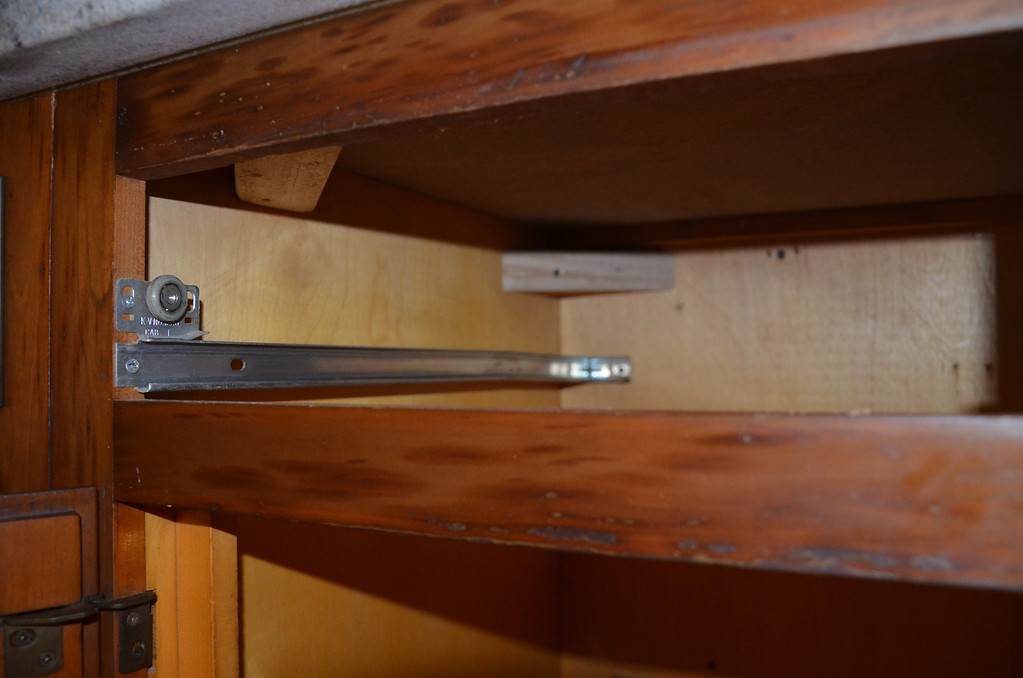
I took off the drawer faces (held in with a block of metal channel) to inspect what I was dealing with. You can see an old slide on the left. You will notice that on the old slide, the slide actually starts about 1/2" back from the face of the cabinet. This means that the style drawers we have, with the face having a protrusion which fits in to the opening, don't work with the new drawer slides I bought. Most modern drawers have the face entirely exterior to the cabinet, which is why the slides are designed to go all the way to the edge of cabinet face.
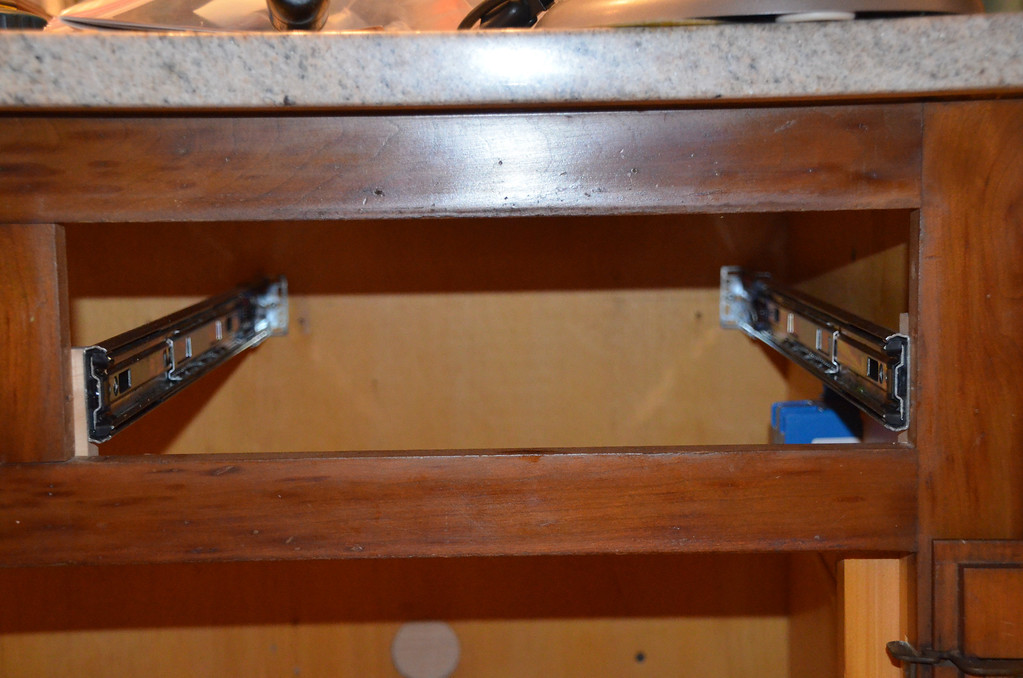
I got around this by making little blocks to attach the slides to inset in the cabinet. I used Knape and Vogt soft close slides. They were a little difficult to get lined up correctly, even when I followed a youtube video on how to do it. The video suggested loosely attaching the rear, installing the drawer, and then tightening. Sounded good.. However, it bound like crazy. I ignored the directions for the left drawer and it is a lot smoother! I simply did it all using measurements and tightened it all down. I adjusted the right drawer but it still isn't as good as the left. Having some weight in them also helps have enough mass to make sure they close and hit the soft close mechanism when you give them a shove.
All in all, they came out pretty well. I both screwed and glued the faces on to make sure they weren't going to loosen up over time. I've also put together some key points I learned doing this in the hopes that I'll remember for the next time.
What I learned:
- Lining up the drawer slides is hard. I think there was a jig I could have bought for like $7, and it would have been worth it.
- I didn't go with undermount slides to match the other slides in the room. In hindsight, nobody would have noticed and I would have had an 8% larger drawer.
- Pick out the drawer slides and then measure for the drawer. I did it in the opposite order and then had to shim as my drawer was a bit too small.
 |
| No drawers, just a left over slide on the left. Ugly pulls are still on in this picture! |
I heard from my dad that David Hurwitz (of Hurwitz Originals) that buying premade drawers was a lot easier and overall cheaper than trying to do them yourself. I'm pretty sure I'd struggle making perfect dovetail joints, so I was more than happy to get drawer.com to do them for me. I later found out that newenglanddrawer.com is probably a lot cheaper, but they didn't reply to my online quote request. The drawers looked great when they came, and with shipping and drawer slide hardware, were just under $100 per drawer. Expensive, but worth having the storage space there.
The drawers looked good when they came, and were right on my specification. I later found out that I should have asked for them 1/4" wider, but all that required was a small shim between the slides.
I took off the drawer faces (held in with a block of metal channel) to inspect what I was dealing with. You can see an old slide on the left. You will notice that on the old slide, the slide actually starts about 1/2" back from the face of the cabinet. This means that the style drawers we have, with the face having a protrusion which fits in to the opening, don't work with the new drawer slides I bought. Most modern drawers have the face entirely exterior to the cabinet, which is why the slides are designed to go all the way to the edge of cabinet face.
 |
| You can see how the old face extends beyond the side of the drawer, but still fits in the opening. New drawers don't do this. |
I got around this by making little blocks to attach the slides to inset in the cabinet. I used Knape and Vogt soft close slides. They were a little difficult to get lined up correctly, even when I followed a youtube video on how to do it. The video suggested loosely attaching the rear, installing the drawer, and then tightening. Sounded good.. However, it bound like crazy. I ignored the directions for the left drawer and it is a lot smoother! I simply did it all using measurements and tightened it all down. I adjusted the right drawer but it still isn't as good as the left. Having some weight in them also helps have enough mass to make sure they close and hit the soft close mechanism when you give them a shove.
 |
| Finished Product! |
What I learned:
- Lining up the drawer slides is hard. I think there was a jig I could have bought for like $7, and it would have been worth it.
- I didn't go with undermount slides to match the other slides in the room. In hindsight, nobody would have noticed and I would have had an 8% larger drawer.
- Pick out the drawer slides and then measure for the drawer. I did it in the opposite order and then had to shim as my drawer was a bit too small.

No comments:
Post a Comment